Thyolo District Council has launched integrated catchment management initiative, a climate resilience programme that promotes sustainable management of land, water and forest resources to improve agricultural productivity in the district.
The council rolled out the initiative on Friday at Njale Primary School in Thyolo Central Extension Planning Area (EPA) where farmers demonstrated a range of climate-smart technologies, including fish farming, banana production, agroforestry, soil and water conservation as well as organic manure-making skills.
Speaking after touring the exhibition, Thyolo District Council chairperson George Jailosi said the initiative offers practical solutions to some of the district’s environmental and agricultural challenges by encouraging communities to adopt sustainable farming practices.
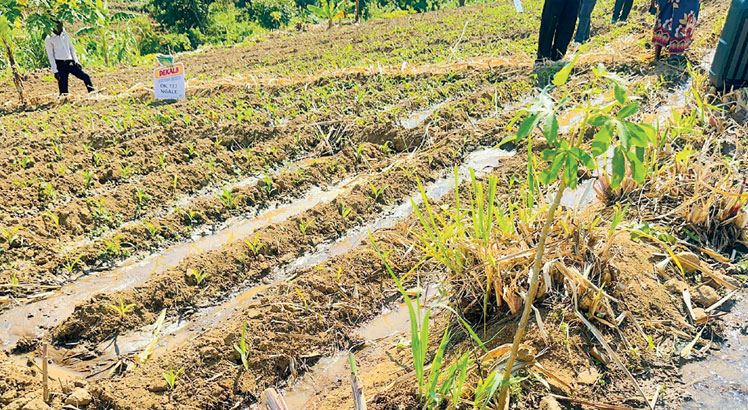
| Yamikani Yapuwa
“We have seen encouraging innovations such as fish farming, banana production, tree-planting and soil conservation. If more people can embrace these practices, we will restore our environment and improve livelihoods,” he said.
The council’s chief agriculture officer Prince Shaibu said the approach enables communities to protect natural resources while increasing agricultural productivity through climate-smart farming practices.
“When we conserve the environment, we protect our soils from erosion, improve water availability and increase the chances of reliable rainfall,” he said.
Sub-Traditional Authority Mulenga urged village heads to ensure that the knowledge and technologies are shared widely for more households to adopt them.
Among the farmers who exhibited their products was Pascal Chikopa who combines fish farming with crop production and tree planting.
“I have four fish ponds and I am able to harvest 300 kilogrammes [kg] of fish from one pond, which I sell at K20 000 per kg, earning about K6.2 million annually from one pond,” he said.
Another farmer, Bester Dick, said adopting terraces, organic manure and irrigation improved both banana production and household income.